Objective:
To implement the Transnational EE Education framework (Figure), facilitating entrepreneurial competency development through collaboration between Home Institutions, Host Institutions, and students. The activity aims to bridge global academic standards with local entrepreneurial needs at the Transnational Education (TNE) provider.
Indicated stakeholders include Home Institutions (HOIs), Host Institutions (HIs), students, and local industries in Host institutions.
It will happen in Small Groups for better discussion, preferably 5-10, depending on stakeholder groups
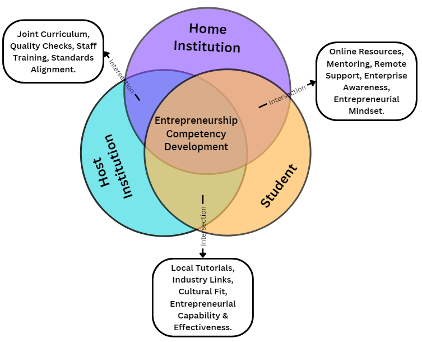
Figure: Integrated Framework for Entrepreneurial Competency Development in TNE
Overview:
This activity is designed to operationalise the TNE Enterprise Education framework, focusing on the intersections between Home Institutions (HOIs), Host Institutions (HIs), and students. Through structured collaboration and resource-sharing, the activity contextualises entrepreneurial skills development such as critical thinking, cultural adaptability, and opportunity recognition. The implementation leverages local insights and global knowledge to create a robust international learning ecosystem.
Activity:
Stakeholder Orientation Session:
- Conduct an initial session to align goals and clarify roles for HOIs, HIs, and students.
- Use interactive presentations to explain the TNE EE framework and its benefits.
- Example: HOIs detail curriculum design, HIs highlight local entrepreneurial contexts, and students share expectations.
Collaborative Curriculum Design Workshop:
- HOIs and HIs co-develop modules focusing on entrepreneurial mindset, capability, and effectiveness.
- Include localised case studies and real-world problem-solving scenarios.
- Example: Create a joint module on "Adapting Global Entrepreneurial Strategies to Local Markets."
Student Engagement Activities:
- Local Tutorials (Host Institution):
- Provide hands-on sessions linking global concepts to local contexts.
- Example: Analyse local market trends and propose actionable business solutions.
- Remote Mentoring (Home Institution):
- Facilitate virtual mentoring sessions with global experts.
- Example: Students receive feedback on business plans from international faculty.
Industry Linkages and Practical Application:
- HIs organise industry visits and guest lectures to bridge academic learning with local entrepreneurial realities.
- Example: Students interact with local entrepreneurs to understand market dynamics.
Feedback and Continuous Improvement:
- Gather input from stakeholders via surveys and focus groups to refine the framework and activity design.
- Adjust delivery methods based on feedback to improve outcomes.
Skill Development:
- Creativity and Innovation: Encourages novel solutions tailored to diverse market needs.
- Cultural Adaptability: Fosters the ability to integrate global insights with local realities.
- Critical Thinking: Enhances analytical skills to evaluate entrepreneurial opportunities.
- Leadership and Teamwork: Builds collaboration and interpersonal skills across cultures.
- Entrepreneurial Capability: Develops hands-on experience in real-world business settings
Resources:
- Digital Platforms: Tools for virtual collaboration and remote mentoring.
- Local Industry Partners: Access to entrepreneurs and industry experts.
- Curriculum Materials: Jointly designed modules and case studies.
- Workshop Tools: Agendas, templates, and feedback mechanisms for structured sessions.
- Faculty Support: Expertise from HOIs and HIs to guide students and align activities with the framework.
References:
- Ahmad, S., Lupton, K., & Rennie, S. (2024). An Integrated Framework for Entrepreneurial Competency Development in Transnational Education (TNE) (working paper).
- QAA (2018). Enterprise and Entrepreneurship Education: Guidance for UK Higher Education Providers.
- European Commission (2018). EntreComp into Action: Get Inspired, Make it Happen.