Objective:
This exercise can be used in multiple situations but the two main ones have different objectives:
As an INDIVIDUAL TASK: The objective is gaining confidence in thinking and acting authentically as an entrepreneur, being given permission that their vision is valid and they don’t have to adopt measures of success offered by others.
For a GROUP: particularly those in the early states of launching a venture, to ensure that vision and expectations are aligned, to facilitate in discussions around roles, articles of association, share agreements, share allocations and desired outcomes for the venture.
Overview:
To explore personal values and vision of success, what is important, motivating and core to the individual/group. If this is a group activity to explore their alignment within the group to avoid unforeseen fundamental differences at a later date that could lead to disagreement or venture failure.
Activity:
There are two activities in this exercise, the first is a REFLECTION ON VALUES, the second is to write a SUCCESS ARTICLE. On the following page is a list of example values that can be used for the first activity. Following that there are instructions for the two activities.
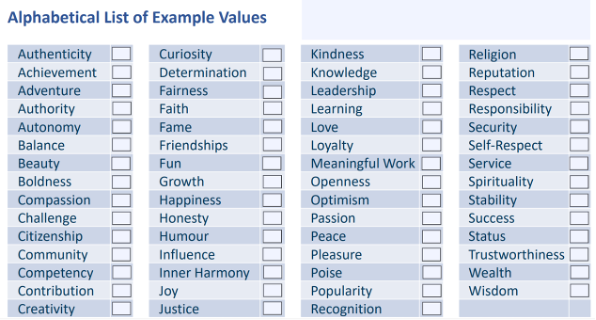
Reflection on Values:
Once you have created your list keep it handy as a guide for future decision making and action – not just as a wall ornament.
Individual Activity(Time for activity: 15 minutes)
Step 1 (5 minutes): From the list (or from a personal list) select 3 – 5 values that are really important to you. If you are choosing between several that you feel are similar think about what makes them different and go for the one that feels the most important to you. Getting down to 5 may be difficult for you but persevere as more than 5 will be too complex to act on.
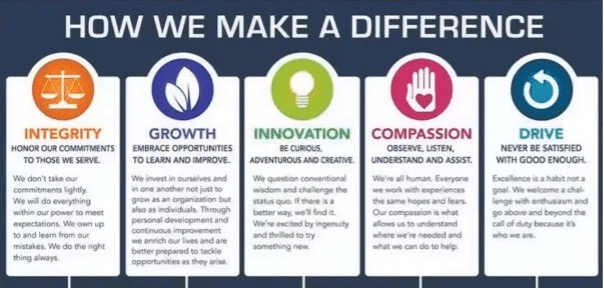
Step 2 (10 minutes): Now that you have your personal selection of 3 – 5 values describe what these values look like in ACTION in your venture. The single word that names a value can mean different things to different people so for greater clarity describe how you act on your value. Many businesses have Values Statements like this to explain to their customers and employees what is important in the business and how it is demonstrated. An example is the one below.
Group Activity(Time for activity: 30 minutes)
There are multiple ways that this activity can be done as a group:
Group discussion from the outset
Dot voting using a large print list on a wall chart
Silent individual activity followed by group discussion
My preferred version is the last one. This gives individuals time to explore and set out their own response before the group discussion.
The group should explore why there are differences rather than trying to persuade everyone to change their perspective. Diversity in business has many benefits but it can also lead to challenges. Discussions like this can open minds, avert future disputes and help in the development of the culture of the venture.

Success Article: Visualisation is a powerful technique. Putting a pin on the map allows you to plan your journey even if you sometimes take a detour.
Individual Activity(Time for activity: 20 minutes)
This activity has four components for you to select/write:
Media: Where would you like your success to be reported? newspaper (local/national), magazine, journal, news broadcaster, social media platform or other news platform. The key is that the medium and its audience should be important to the individual. Being celebrated here should feel like an achievement for them.
Date: Think about how long it is going to take to achieve the success that you are reporting – 2 years, 5 years, 10 years? The date is an important SMART measure and can later be used to create a milestone timeline and subsequently project planning.
Headline:In an eye-catching headline concisely capture the essence of your success, your choice of media should help give a voice/style for this.
Metrics: Write a paragraph giving examples of what success looks or feels liketo you. It might be money and fameor it could be registering a patent, a community project, employing people, a new building, a product launch,a contract award, reducing waste, lives saved or changed, building something important, making your mark. Success means different things to different people, what does it mean to you? (SMART objectives)
Remember you are not writing about what you want to achieve but a future report of you having achieved these objectives.
Often there are assumptions about WHY people start a venture which can shape training, advice, discussions. Holding a clear vision of what success means to you will help you be selective in the advice you take or be able to provide a different point of view in training that you participate in. Holding a vision of success that is different from the average may be the thing that sets your venture apart for your customers, staff and community.
Group Activity(Time for activity: 40-60 minutes)
For the first 20 minutes each group member silently follows the instructions for the individual activity.
Then each member of the group shares their vision of success with their group, followed by a group discussion.
There will be a spectrum of scenarios:
Complete accord in a shared vision of success
Differences in metrics but not opposing visions
Entirely different and opposing visions of success
Whether there is complete accord (delighted discussion) or opposing visions (difficult discussion) or somewhere in between (opportunity for encompassing additional metrics) the sooner everyone in a team knows what motivates their team mates the better. If it can’t be fixed better to split the group now than after five years of pulling in different directions.
If the group falls somewhere in the middle maybe the differences can highlight different or additional aspects of the venture that it would give them satisfaction to work on.
See also the task objectives (p1) for role in group governance discussions.
This is also a great exercise for teams to do or revisit as part of ‘working-on-the-business instead of in-the-business’. Time out to refocus, regroup, realign and take onboard all the changes that happen to ventures and the people in them along the way which can affect the aspirations and outcomes for the group/venture.
Competence Building:These activities lean into the three core sections of the Entrecomp Framework:
Ideas & Opportunities – especially Vision and Ethical & Sustainable Thinking
Into Action – especially Working with Others and Planning & Management
Resources – especially Self-Awareness/Self-Efficacy and Motivation & Perseverance
Subsequently these activities can be revisited and linked to all stages of the validation process and to operational decisions thereafter:
DESIRABILITY: how will your values affect how you act with customers? The creation of brand identity and a brand values statement. If the values change, reflect on why.
FEASIBILITY: how do your values affect how you operate, manage resources, select and interact with Key Partners, make choices about supplies, suppliers and your supply chain?
VIABILITY: what impact do your values have on the bottom line? Will you uphold your values or change them? Opportunities for reflection.
These touch-points provide a holistic view of the connection between individual and venture operation and provide an opportunity to explore what authentic entrepreneurship means to the individual/group. For those with questions or qualms about entrepreneurship this can be a reassuring process to enable them not to feel a loss of identity or control.
Skill Development:
- Reflective thinking
- Decision making and developing decision tools and strategies
- Self-awareness and self-efficacy
- Communication with different audiences (co-founders, customers)
Resources:
- Paper and pens
- A list of values (optional)
- A pre-printed template for the article (optional)
- Time for reflection/discussion
Follow up activities and reading:
Key authors: Simon Sinek (books on purpose/motivation), YouTube:
Books: “Will it make the boat go faster?” by Harriet Beveridge & Ben Hunt-Davis. The story of Olympic success and simplifying decision-making processes to achieve it – translated to this exercise “does it achieve the desired success?”. The book explores strategies, habits and mindsets for success.