Objective:
- The learner will understand how to map their innovation to the target market, evidence the appropriate TRL (if technological) and identify any appropriate regulatory pathways.
- The learner will identify all collaborative partners and previous research involved in order to appropriately apportion IP.
- The learner will identify non-commercial impacts (knowledge exchange) of the proposed innovation.
Overview:
Identifying agile, value-led tools to map innovation is becoming increasingly relevant in higher education. Whether the user is a student start-up, an academic spin-out or a multi-centre collaborative project, the need to transparently map and communicate complex innovation is a powerful tool.
Activity: (Potentially long – if including timings; approach; extensions; assessment; options for delivery)
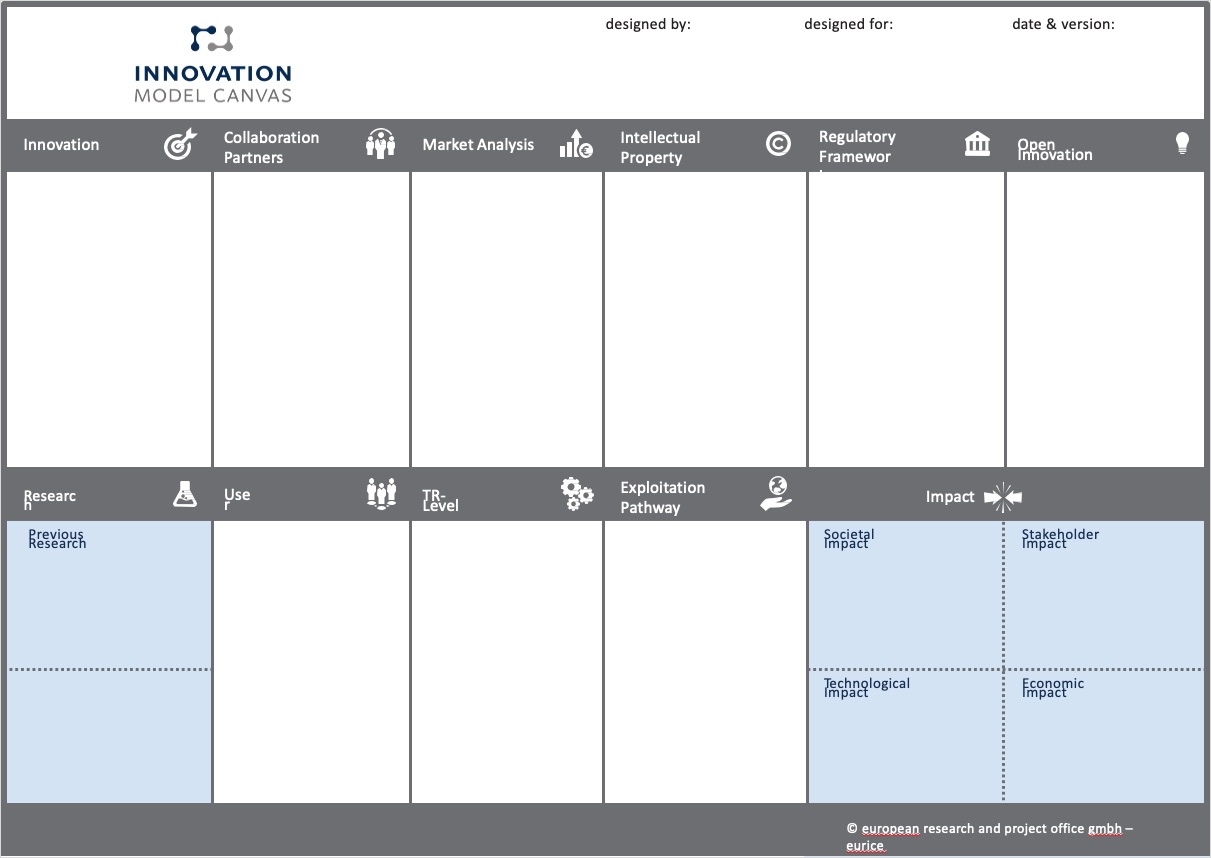
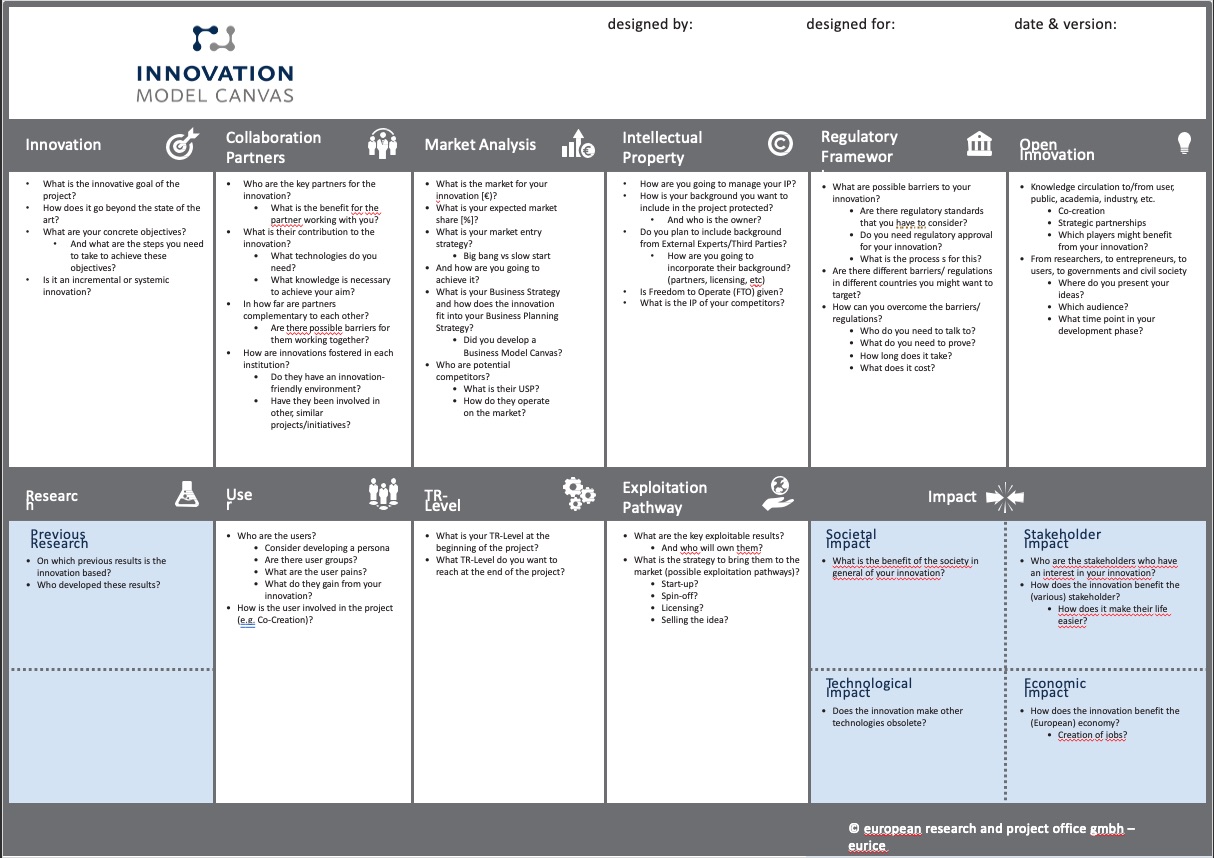
Using the EURICE Innovation Model Canvas, a facilitator will guide a discussion using the Innovation Model Canvas as a tool to highlight and map the innovation from its inception through to potential future delivery of translational impact.
Define the innovation: describe the innovation developed and explain how it goes beyond the state-of-the-art in the respective field
Collaborative partners: identify the partners required to deliver and implement (or those who have contributed in any way to the delivery and implementation) of the innovation.
Market analysis: identify any competitor alternatives to the innovation and describe the market landscape. N.B.: this can be a detailed section outlining expected market size and estimated market share if appropriate.
Intellectual property: list any background IP (and to whom this belongs, ensuring that these are also entered on the ‘Collaborative Partners’ list) and management plan for any foreground IP.
Regulatory framework: describe any regulatory barriers, relevant standards or guidelines that have to be (or have been) considered throughout the implementation.
Open innovation: describe any planned open innovation approaches (co-creation and strategic partnerships) that have resulted, or are planned, during the innovation lifecycle.
Research: list any previously related research or any future application areas that have been identified (futureapplications can also be translational beyond the initial area).
User: describe the end-user in detail and highlight how the proposed innovation will add value to them/their work, etc.
Technology readiness level: if a technology develop is involved in the innovation, identify the TRL to allow for the required timeline and steps in the development process. This section will help inform discussions with any stakeholders and manage expectations.
Exploitation pathway: describe the intended application area of the innovation within any/all identified application areas.
Impact: describe any proposed or planned impact the innovation is intended to have. This section of the canvas has been broken down into societal, stakeholder, technological and economic. This may be particularly relevant for education enterprise innovation where national benchmarking and framework exercises require impact statements.
Skill Development: (short – focus on reflection; review; feedback; learning) Planning, communication, feedback and enterprise strategy.
Resources:
- Post-its or similar sticky pads
- Pens
- Virtual whiteboard
References:
Jakob Haardt. Senior Research & Innovation Manager, Eurice Gmbh, Berlin Office. https://www.eurice.eu/team/ j.haardt@eurice.eu
Metcalf, C.D. & Haardt, J. Capturing, supporting and translating collaborative innovation for financial and reputational revenue: Innovation Model Canvas for Knowledge Exchange. Innovation: Organization & Management (in review).