Objective:
- A discipline specific 10 credit commercialisation module developed as part of the Cardiff University Enterprise commercialisation module framework.
- The module utilises a range of contemporary pedagogical approaches aimed at developing innovative and commercially aware physics graduates.
Introduction:
2013 saw the adoption of an enterprise education module entitled ‘Commercialising Innovation’ by the Cardiff School of Physics and Astronomy, making it available to 21 students from the physics cohort. Delivered via an innovative collaboration between Cardiff University enterprise, engineering and physics staff, the module encourages elements of cross disciplinary cooperation between students.
Cardiff University Enterprise worked closely with Dr. Annabel Cartwright, Dr. Jeremy Hall and Dr. Peter Hargrave, all supportive advocates for the adoption of the module by the Cardiff School of Physics and Astronomy.
The adoption of the Commercialising Innovation module provides Cardiff University students of physics with an applied introduction to the commercial process whilst providing opportunity for the development of practical enterprise and employability skills intended for application within industrial contexts.
During the first year of delivery a partnership between Cardiff Schools of Engineering and Physics reflects the needs of industry for graduates who are experienced and have the appropriate skills in order to work collaboratively with colleagues from a variety of differing disciplinary specialisms in order to take innovative ideas to market. Exposure to one another’s discipline in the context of the commercialisation module provides both physics and engineering students with broader insight into the potential modes of application of their own disciplinary learning within an industry based context.
Examples include;
- Drawing upon data which shows the number of registered businesses in physics based sectors as increasing by 31% between 2005 and 2010, the Institute of Physics 2012 report ‘The Importance of Physics to the UK Economy’ (authored by Deloitte) identifies the application of physics to commercial activities as potentially playing an important role in creating new business and being an engine of enterprise within the UK.
- The QAA subject benchmarks document for Physics published in 2008 identifies a range of skills and aptitudes expected of a Physics graduate in the UK. These skills include creativity, problem solving, communication and collaboration, investigation, analysis and evaluation and project work – all key enterprise skills developed within the Commercialising Innovation module.
Activity:
- Drawing upon previous iterations of the Commercialising Innovation module delivered in the Cardiff School of Engineering for the previous two years, the physics implementation of the module utilises the innovative pedagogical approaches employed by the Cardiff University Enterprise commercialisation module framework.
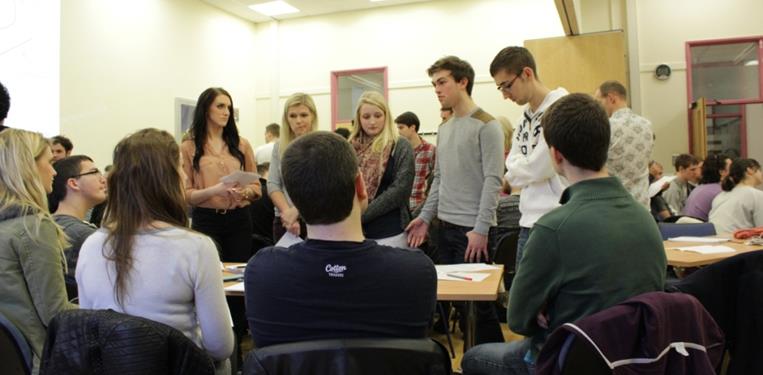
- The component active learning tasks are approached by students in the context of ‘company teams’, providing fertile ground for the development of practical enterprise and employability skills.
- Theoretical and practical learning is further contextualised by the use of real world examples of discipline/sector specific innovation commercialisation, communicated to learners by experienced and relevant external speakers and the use of pertinent case studies.
- Students engage with a comprehensive range of enterprise skills and associated learning outcomes. Summative assessment for the module required learners (as part of ‘company teams’) to generate a feasibility study, deliver a presentational pitch for their (simulated) company and commercialisation and submit an individual reflective report requiring them to analyse and evaluate their own personal learning development during the learning programme.
Impact:
- In its first year of availability across Physics and Astronomy, the module attracted 19 students, while in during its second year 40 students opted to take the module.
Learner Outcome:
Examples of student reflection;
“I really feel that this project, because it has been so different from a usual physics course, has developed my character in a way I wouldn’t have otherwise been exposed to.”
“Aside from acquiring business knowledge, I also feel that through the completion of this module I have developed a skill set that is essential for life after university.”
"I would highly recommend this module to others, as I think it is a nice change from the normal modules, but it is also very beneficial in teaching skills required for the future in jobs or other presentation based modules.”
The examples of curriculum development for enterprise related outcomes were originally outlined by Neil Coles at the International Enterprise Educators Conference under the heading 'From Archaeology to Zoology; an A-Z of enterprise in the curriculum'. For his work in contextualising enterprise for any subject, Neil won the 2013 National Enterprise Educator Award.
Resources:
- For a How To Guide on developing presentation skills, see ‘Workshop: How to Speak in Public’
- For a How To Guide on utilising external presenters, see ‘Guest Lecture Guidance’
References:
- The Importance of Physics to the UK economy. 2015. [ONLINE] Available at: http://www.iop.org/publications/iop/2012/file_58713.pdf. [Accessed 03 August 2015].
- Cardiff University School of Physics and Astronomy. 2015. [ONLINE] Available at: http://www.astro.cf.ac.uk/. [Accessed 03 August 2015].
- Cardiff University Enterprise | Be Enterprising | Make Things Happen. 2015. [ONLINE] Available at: http://sites.cardiff.ac.uk/cuenterprise/. [Accessed 03 August 2015].
Author/Contact Details:
- Neil Coles, Senior Enterprise Learning Officer, Cardiff University